
Guide · Planning your Faroe Islands elopement
How to elope in the Faroe Islands
This is the guide I wish every couple had before our first call. It covers getting married in the Faroe Islands, the best time to go, what it costs, where to go and how to get there from the US.
I'm Aleks, a Faroe Islands wedding and elopement photographer based in Copenhagen. Facts like fees and flight routes change, so I've noted where you should double-check. If something here doesn't answer your question, ask me.
01 · Getting married
Getting married in the Faroe Islands
Legal or symbolic?
You have two options. You can have a legal civil ceremony in the Faroe Islands. Or you can sign the papers at home and have a symbolic ceremony on the islands, wherever and however you like.
Many couples choose the second. A symbolic ceremony has no paperwork deadlines, no fixed venue and no limit on where you stand. A legal ceremony takes more planning, but it means the day you see in the photographs is the day you actually got married.
How a legal civil ceremony works
Civil weddings for visitors are handled by the local municipality. As an example, Vágar (the island with the airport) asks couples to:
- Email the municipality to check dates and times
- Submit a "Notice of Marriage" form at least four months before the ceremony
- Send birth certificates and proof of current marital status, plus final divorce papers or a death certificate if relevant
- Have documents not in English translated by an authorized translator
- Bring two witnesses, or ask the municipality to provide two staff members
Requirements and fees are set by the municipality, so confirm them with the municipality before you plan. I'm happy to point you to the right contact.
After the ceremony you receive an international marriage certificate in Faroese and English.
Tórshavn has also held civil ceremonies for many foreign couples, and in 2020 it moved to charge foreign nationals an application fee. Confirm the current fee with the municipality.
Can we marry in a church?
Church weddings in the Church of the Faroe Islands are for couples where at least one partner belongs to the church, or, for couples from outside the Nordic countries, where one partner is or has been a Faroese citizen. For most visiting couples, that means a civil ceremony or a symbolic one. If a village church matters to you, ask the parish.
US citizens
US citizens can marry in the Faroe Islands under the same civil process. A marriage that is legally performed abroad is generally recognized in the US, but check with your home state. Ask the US embassy in Copenhagen or your own state or records office whether you need an apostille.
Same-sex couples
Same-sex civil marriage has been legal in the Faroe Islands since July 1, 2017. The first same-sex wedding took place in September 2017, between a British couple.
Officiants and guests
For a legal ceremony, the municipality provides the official. For a symbolic ceremony, you can ask a friend, write your own vows, or have no officiant at all. I work with a wide network of local vendors, including celebrants, and share my recommendations once your booking is confirmed.
Guests are up to you. Most elopements I photograph are just the two of you, or a small group. Bigger groups need more cars, more rooms and more careful location choices, so tell me early.
FAQ: Getting married
What's the difference between a legal and a symbolic ceremony?
A legal ceremony is your official marriage, with paperwork filed months ahead. A symbolic ceremony is everything else: vows, rings, the people you love, but no legal paperwork on the day. Many couples sign at home first, then make their Faroe ceremony entirely their own.
Can US citizens get married in the Faroe Islands?
Yes, through a civil ceremony at the local municipality, with notice given in advance. Vágar, for example, asks for notice at least four months before.
Can same-sex couples marry in the Faroe Islands?
Yes. Civil same-sex marriage has been legal since July 2017.
How many guests can we bring?
As many as you like, though most couples keep it small. Remember that roads are narrow, some locations need a walk, and summer accommodation is limited.
Do we need an officiant?
For a legal ceremony, the municipality arranges it. For a symbolic one, no. You can read vows to each other, or ask someone you love to lead it.
Is eloping worth it?
For a lot of couples, yes. You spend your budget on the trip and the experience instead of a large event, and the day is about the two of you. It isn't for everyone. If having everyone there matters most, an intimate wedding with a few guests is a good middle ground.
Which European country is easiest to elope in?
Honestly, mainland Denmark is known as one of the simplest. Couples apply to the Danish Agency of Family Law (Familieretshuset), and processing is often quick once documents are complete. Check current fees and timing with the agency before you plan. Some couples marry legally in Copenhagen and then hold a symbolic ceremony in the Faroes. I photograph in Copenhagen too: aleksjakobsons.com.
Questions about your ceremony? Tell me about your plans.
02 · Best time
Best time to elope in the Faroe Islands
There's no wrong month, only different trade-offs. Summer gives you long days and milder weather, with more people and higher prices. Spring and autumn are quieter, with lower sun and more dramatic light. Winter is short on daylight and often stormy.
It will rain at some point in any season. Tórshavn averages about 1,400 mm of rain a year, and the national climate report counts roughly 265 days with some rain. That's normal here, and we plan for it.
Season by season
| Season | Daylight (approx.) | Typical temps | Crowds | Notes |
|---|---|---|---|---|
| Jan – Feb | 5–10 hours | 4°C / 39°F | Very few visitors | Short, low light, and wet on average. Winter weather can make some roads and hikes harder. |
| Mar – Apr | 10–16 hours | 4–6°C / 40–42°F | Quiet | Light returns fast. Spring is lambing season; respect fenced land. |
| May | 16–19 hours | 7°C / 45°F | Building | The sunniest and one of the driest months on average. A good balance of light and quiet. The "Closed for Maintenance" weekend falls around the start of May (April 30 to May 2 in 2026). |
| Jun – Jul | 17–20 hours | 9–11°C / 48–52°F | Peak season | Very long days, late sunsets, and the driest part of the year on average. Book cars and rooms early. |
| Aug | 14–17 hours | 11°C / 52°F | Busy | The warmest month on average, with earlier, softer evenings. |
| Sep – Oct | 8–14 hours | 8–10°C / 46–50°F | Quieter | Lower sun, moodier light, and rain returns as the days shorten. Usually better value than summer. |
| Nov – Dec | 5–8 hours | 4–6°C / 39–43°F | Very few visitors | The darkest and one of the wettest times of year. Only for couples who want the storm. |
My favorite months to photograph are the summer months, September included. The days are long, the light has room to change, and there is more time to follow the weather. That said, I have worked here through rain, wind and fog, and good photographs happen in every season.
FAQ: Best time
What is the best month to elope in the Faroe Islands?
For most couples, May to early September. May and June are the sunniest and driest months on average, June has the longest days, and July and August are the mildest. May and September are quieter. If you love moody light and don't mind wind, late September and October are worth a look.
What's the weather like by season?
Mild and changeable all year. Average temperatures range roughly from 4°C (39°F) in winter to around 11°C (52°F) in summer, and rain is possible any day. Fog can come and go within an hour.
What if it rains on our day?
Then we work with it. Every plan has a backup, and I shift locations or timing to where the light and wind are kinder. Rain, mist and low cloud often make the most honest photographs here.
How many days should we plan?
At least four or five days on the islands, so you have a buffer around your elopement day for weather and travel delays. A week lets you explore without rushing.
What's the cheapest month?
Winter, and the shoulder months of spring and late autumn, usually mean cheaper rental cars and easier-to-find rooms than June to August. Shorter days mean less time to photograph, so it's a trade-off.
Not sure which month fits? Send me your rough dates.
03 · Cost
What a Faroe Islands elopement costs
The Faroe Islands aren't cheap. Most of the cost is the trip itself: flights, a rental car, and somewhere to stay. Here's a realistic starting point for two people for about five nights in summer. Every figure is a rough estimate, so check current prices.
Sample budget (two people, ~5 nights, summer)
| Item | Rough range (USD) | Notes |
|---|---|---|
| Flights from the US | Rough estimate: $1,800–$3,600 for two. Varies by season and how early you book; check current prices. | One stop via Reykjavík or Copenhagen. Varies a lot by city and season. |
| Rental car | $500–$1,000 | Roughly $100–$170 a day for a compact car in summer, more for an SUV. Book early for summer. |
| Tunnel tolls | $30–$150 | Subsea tunnels to Eysturoy and Sandoy are DKK 175 one way; Vágar and Norðoy tunnels DKK 100 return for rental cars. Ask your rental company, as some charge differently. |
| Accommodation | Rough estimate: $900–$2,000. Varies by season and how early you book; check current prices. | Hotels, guesthouses or a cottage. Limited supply in summer. |
| Sustainability fee | About $30 | DKK 20 per person (16+) per night in paid accommodation, from February 1, 2026. For two people over five nights that is DKK 200. |
| Site / hiking fees | $0–$150 | Some places charge, e.g. DKK 200 per person at Trælanípa without a guide, or DKK 200 per adult at Kallur. |
| Legal marriage fees | Set by the municipality | Ask the municipality directly for the current fee. Depends on the municipality. Tórshavn moved to charge foreign couples a fee in 2020. |
| Food | Rough estimate: $500–$1,000. Varies by season; check current prices. | Restaurants are pricey; supermarkets help. Budget guides put a casual restaurant meal at roughly $25–$40 per person. |
| Flowers, hair and makeup | Rough estimate varies; ask for quotes | Limited local options. Ask me who I'd recommend. |
| Photography | See Packages | My flights and accommodation are included. |
FAQ: Cost
How much does a Faroe Islands elopement cost in total?
For two people, the trip alone (flights, car, stay, food and fees) is often somewhere around $4,000–$8,000 as a rough estimate, depending on season, how early you book and how you travel. Check current prices. Photography comes on top of that. You'll find my prices on the packages page.
Are the Faroe Islands expensive?
Yes. Food, rental cars and accommodation cost more than in most of Europe, and supply is limited in summer. You can save by staying in self-catering places and booking early.
Is it cheaper to elope in Europe than to have a wedding in the US?
Often, yes. The Knot's 2026 Real Weddings Study put the average US wedding at about $34,200, for around 117 guests. An elopement in the Faroes, even with flights and a few nights on the islands, usually costs well below that, because you're paying for a trip, not a big event. It depends on how many people you bring.
Who usually pays for an elopement?
Most couples pay for it themselves. Some families offer to help with part of it, like flights or photography, in place of hosting a larger wedding. There's no rule.
Want to see what photography costs? See packages.
04 · Locations
Elopement locations in the Faroe Islands
The islands are small enough that you can see several places in one day. We choose them together for light, access, privacy and how far you're happy to walk.
A note on land and fees. Most land in the Faroes is privately owned or farmed, and a few popular sites charge a fee or require a guide. Stay on paths, close gates and keep away from sheep, especially in spring. For many popular trails, landowners or local groups run an online booking portal, a payment box at the trailhead, or a mandatory guided tour (Drangarnir is one example). I plan these well in advance for couples.
-
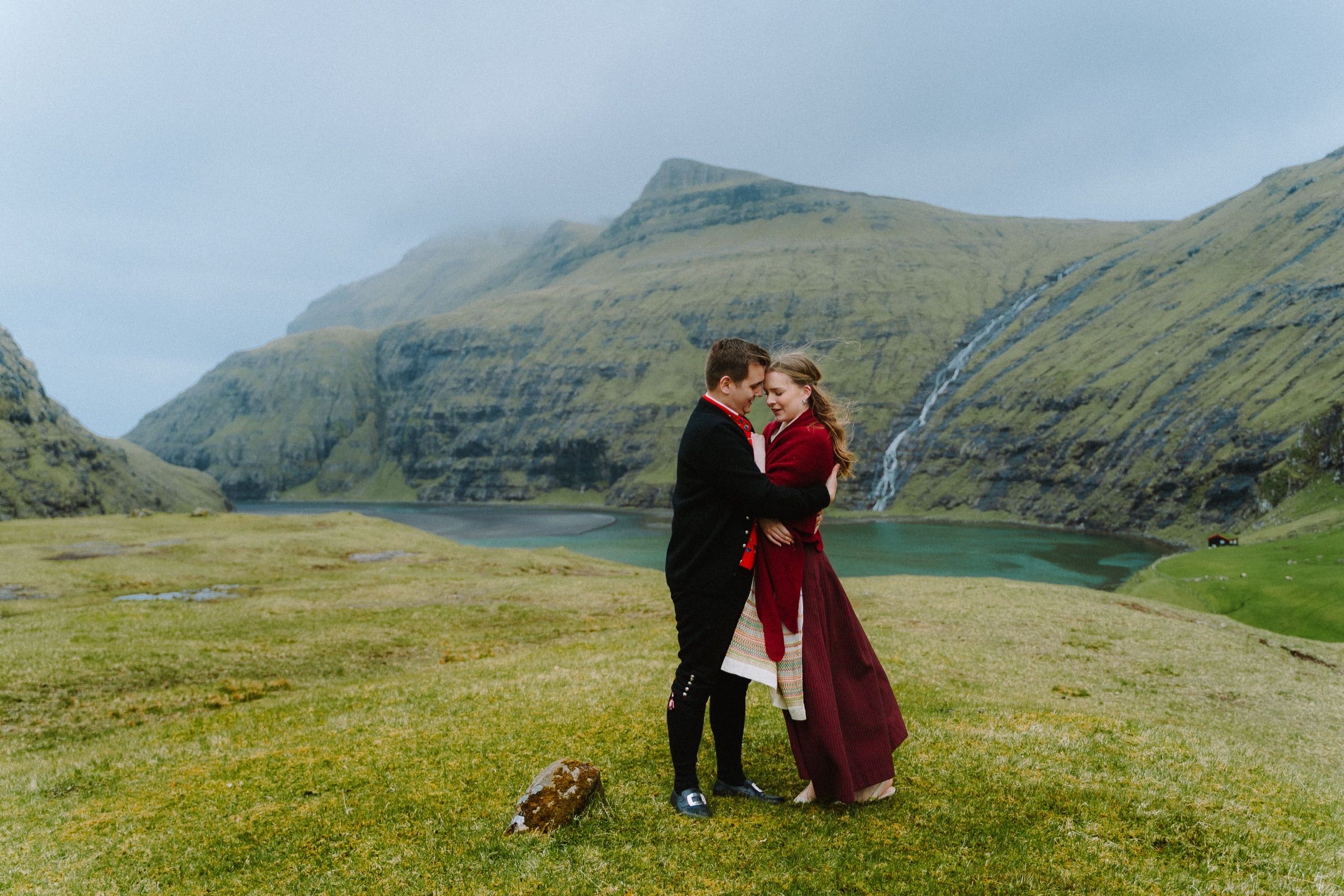
Saksun (Streymoy)
A small village at the end of a valley, with a turf-roof church and a tidal lagoon. Walking out to the beach crosses farmland, and the farmer has charged a fee for the path. Fees change, so check before you go. Low cloud changes it completely.
-
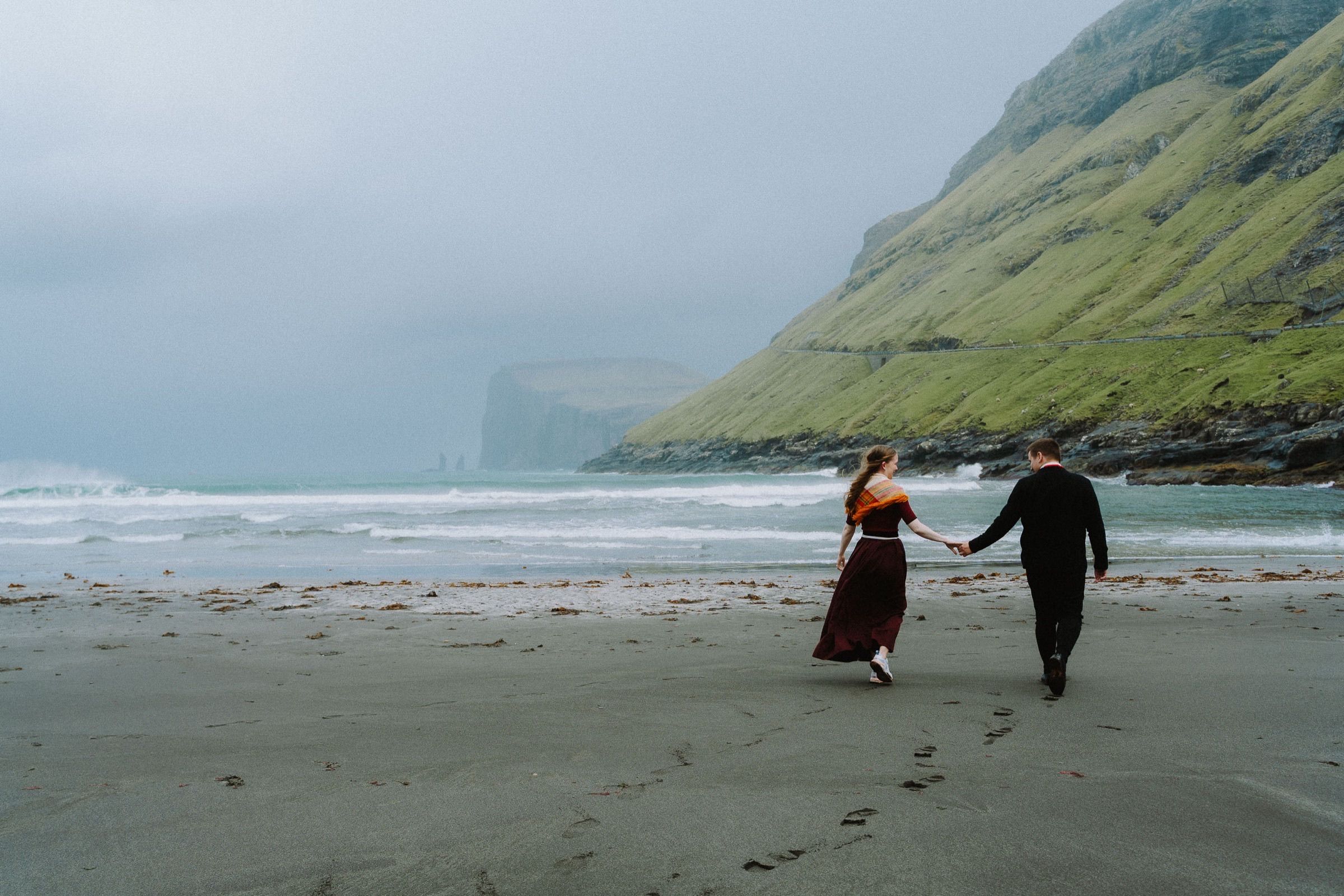
Tjørnuvík (Streymoy)
The northernmost village on Streymoy, with a dark sand beach and a view across the water toward the sea stacks Risin and Kellingin. It's often windy, which suits loose hair and long walks.
-
Fossá (Streymoy)
Fossá is the tallest waterfall in the Faroes, about 140 meters in two tiers, right beside the road on the way to Tjørnuvík. Easy to reach, which makes it good for guests. The lay-bys are small and fill up in July and August.
-
Eiðisvatn (Eysturoy)
A lake by the village of Eiði in the north of Eysturoy, with open views toward the hills. Good for a quiet ceremony in soft light.
-
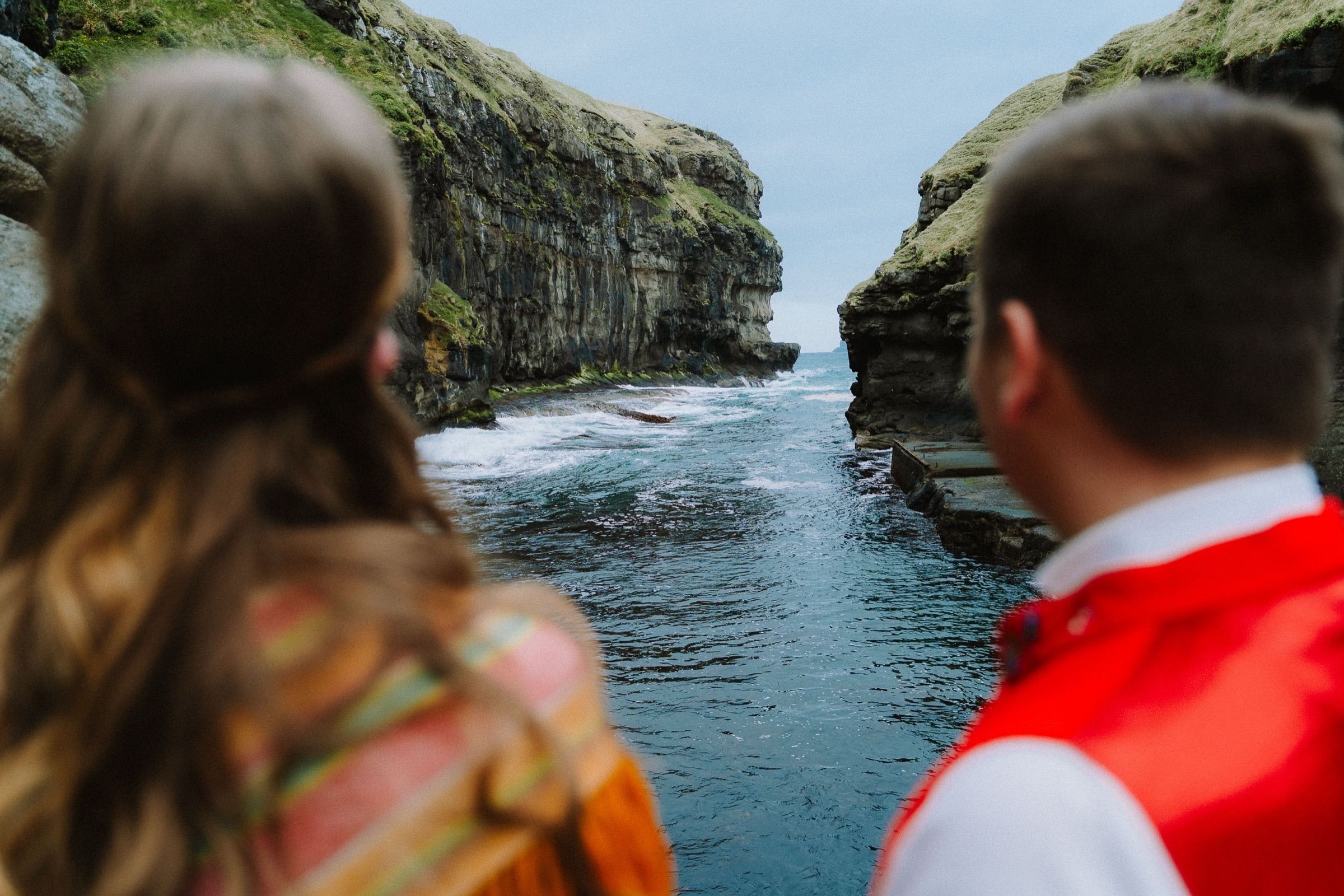
Gjógv (Eysturoy)
A village built around a gorge about 200 meters long that has served as a natural harbor for centuries, with steep grass slopes above it. Easy walking, with a guesthouse in the village.
-
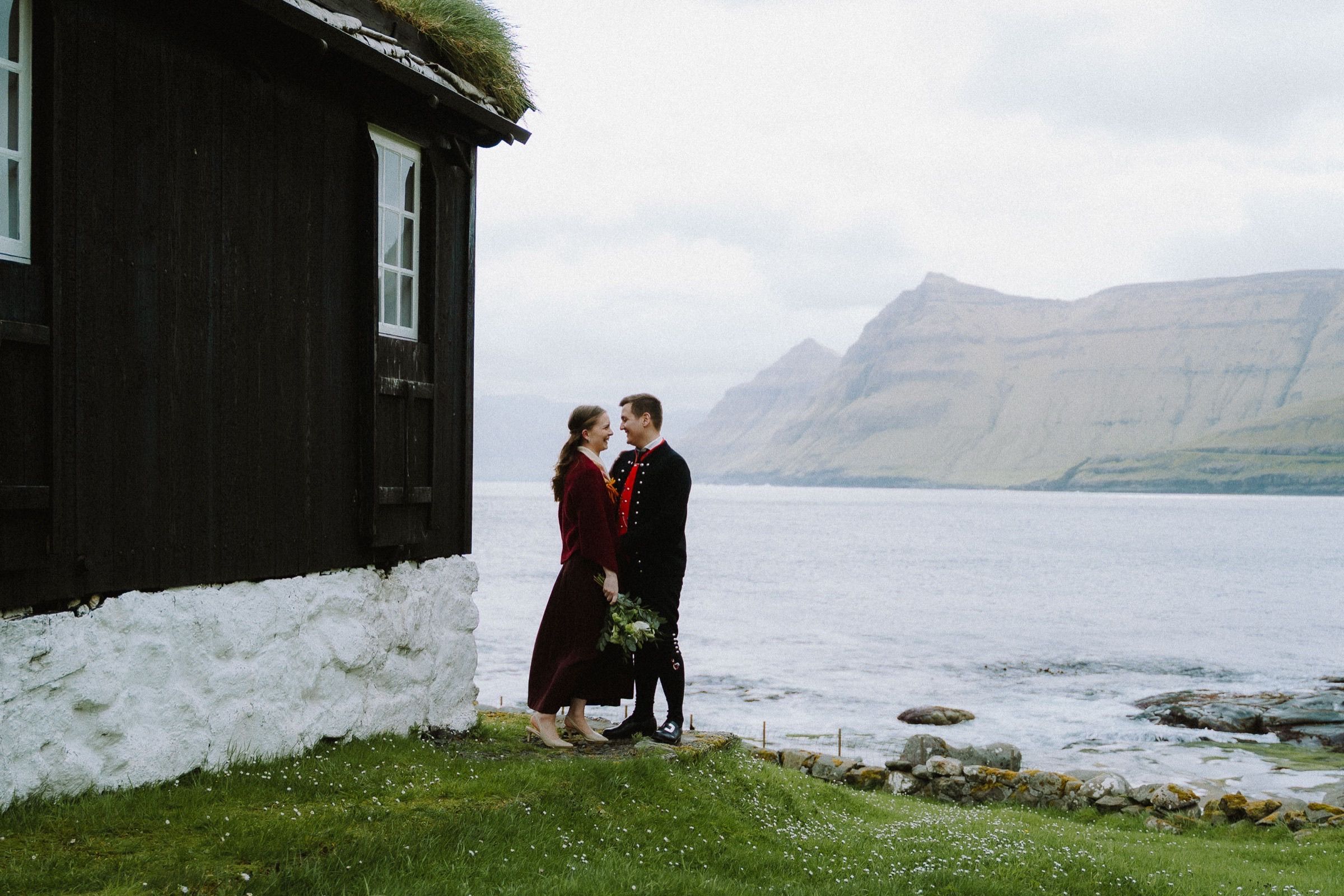
Funningur (Eysturoy)
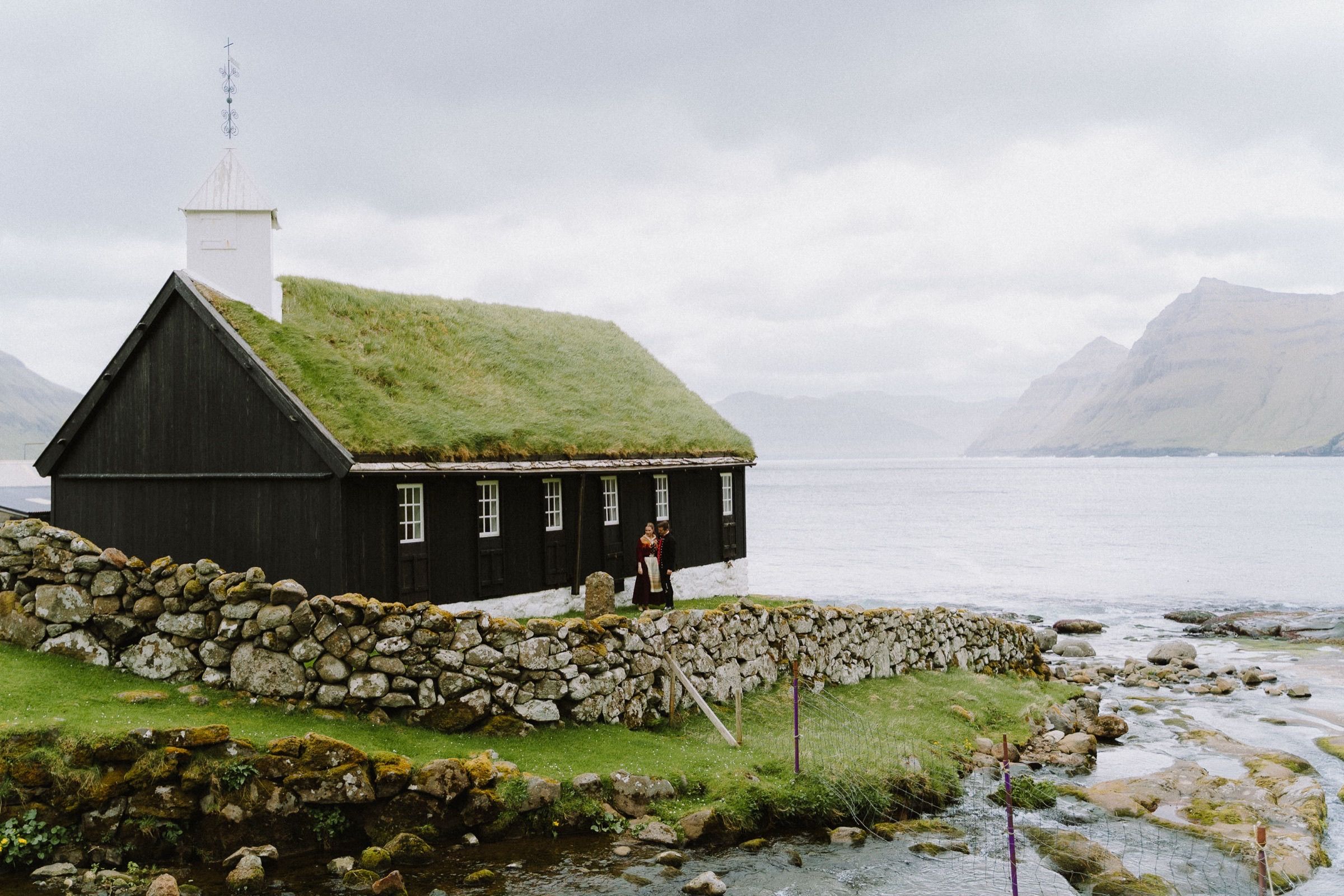
A small fjord village with a black wooden church from 1847, with a turf roof. Slættaratindur, the highest mountain in the Faroes, stands nearby.
-
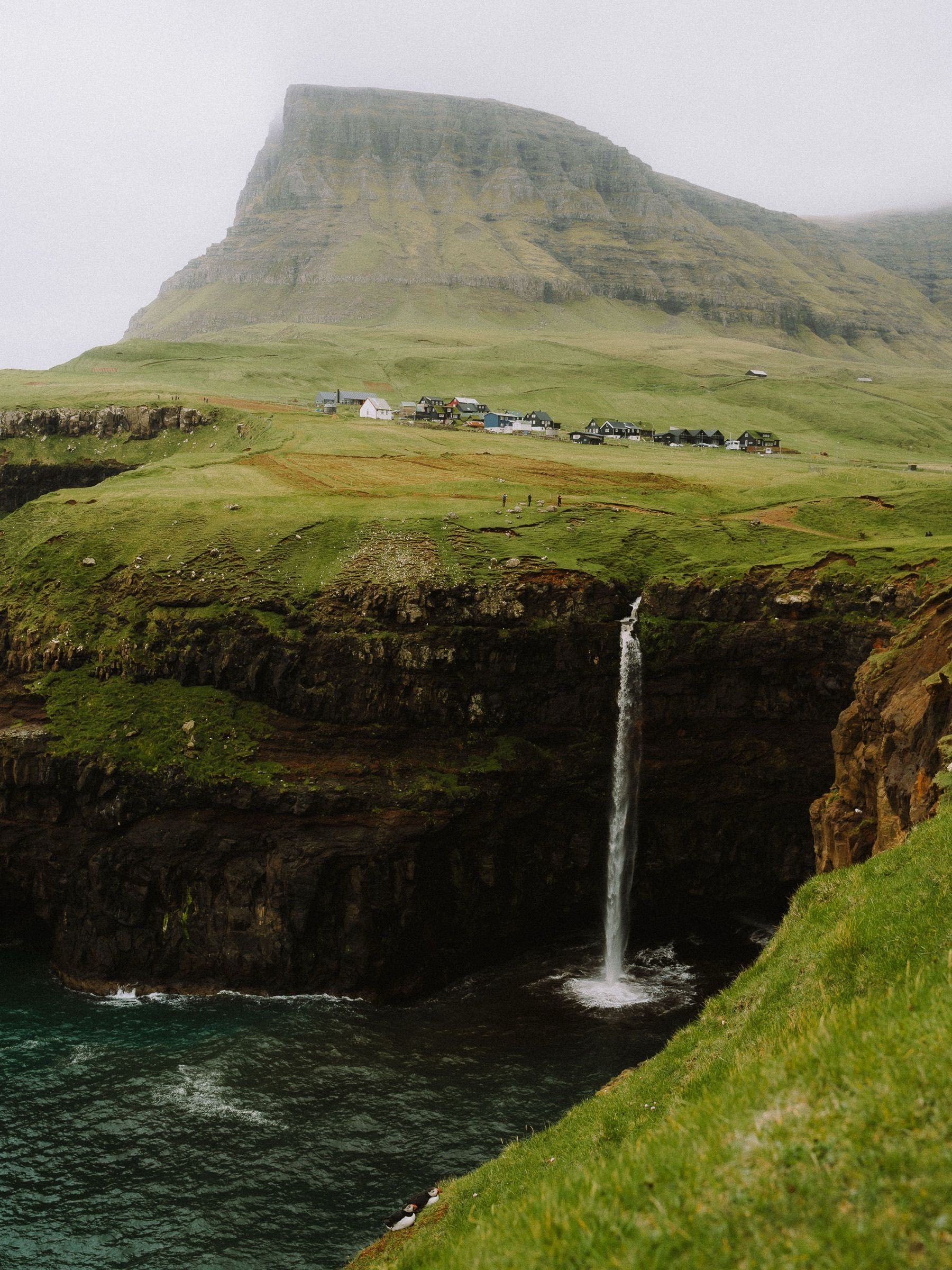
Múlafossur and Gásadalur (Vágar)
Múlafossur is a waterfall dropping from the cliffs beside Gásadalur straight into the sea, on Vágar, where the airport is. Well known and busy in summer, so timing matters.
-
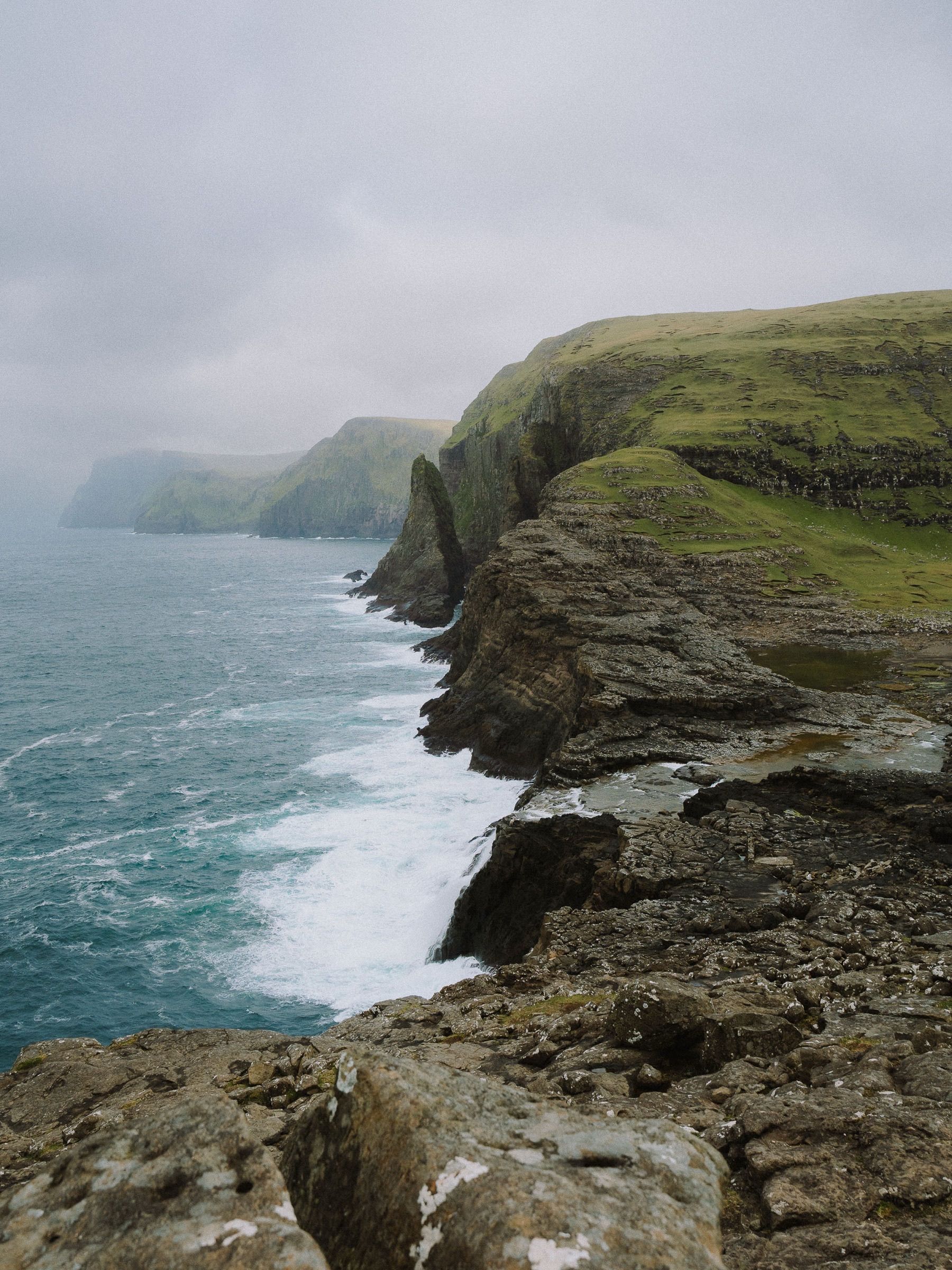
Bøsdalafossur and Trælanípa (Vágar)
The walk along Sørvágsvatn/Leitisvatn to the cliffs at Trælanípa and the Bøsdalafossur waterfall. There is a mandatory fee: DKK 200 per person without a guide, or DKK 450 per adult with a guide, per Visit Faroe Islands (the page says fees are under review). Allow a few hours for the walk.
-
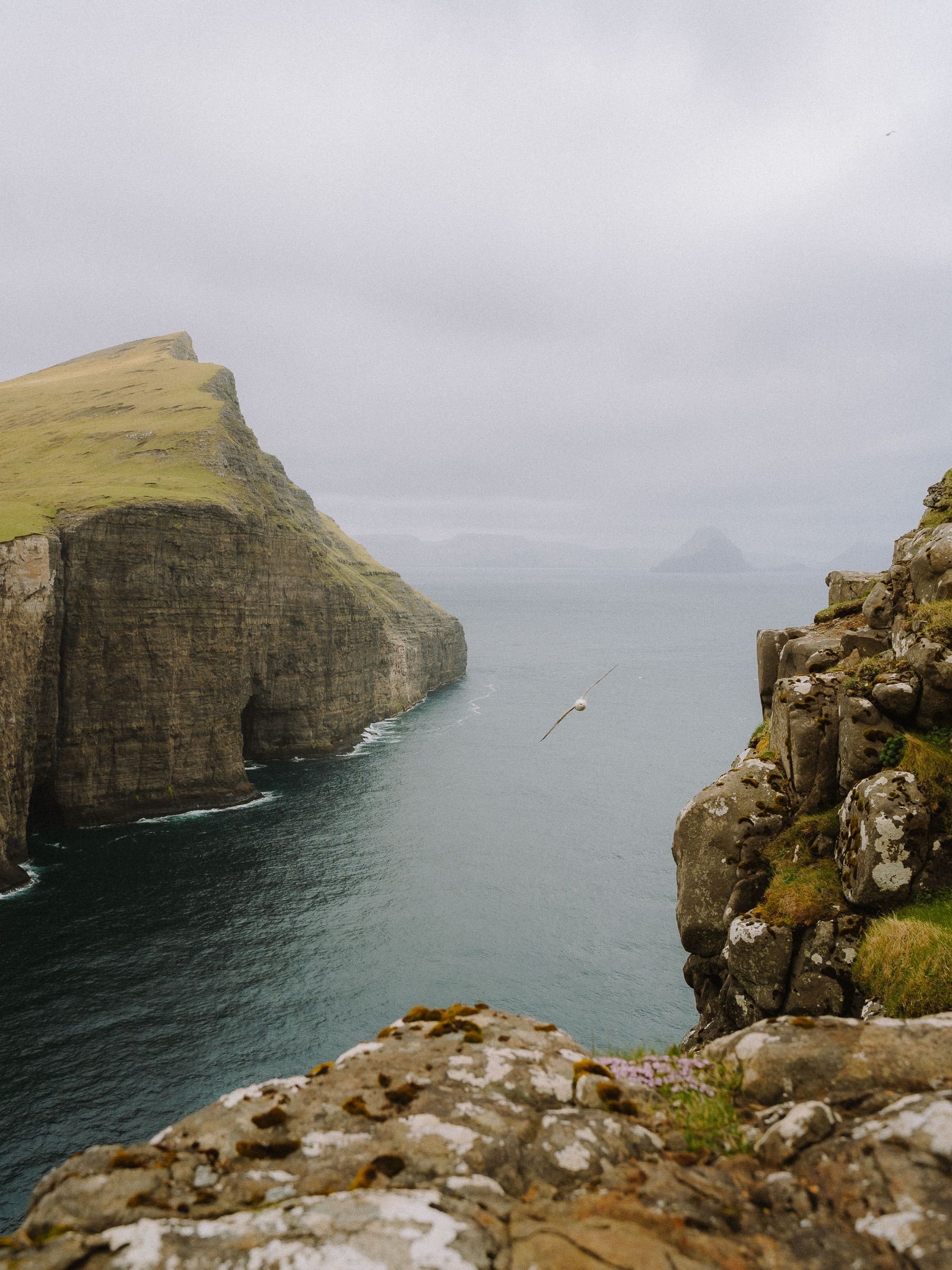
Sørvágsvatn (Vágar)
The largest lake in the Faroes, seen from the cliffs as if it sits above the ocean. The famous view is from the Trælanípa side, so the fee above applies.
-
Kirkjubøur (Streymoy)
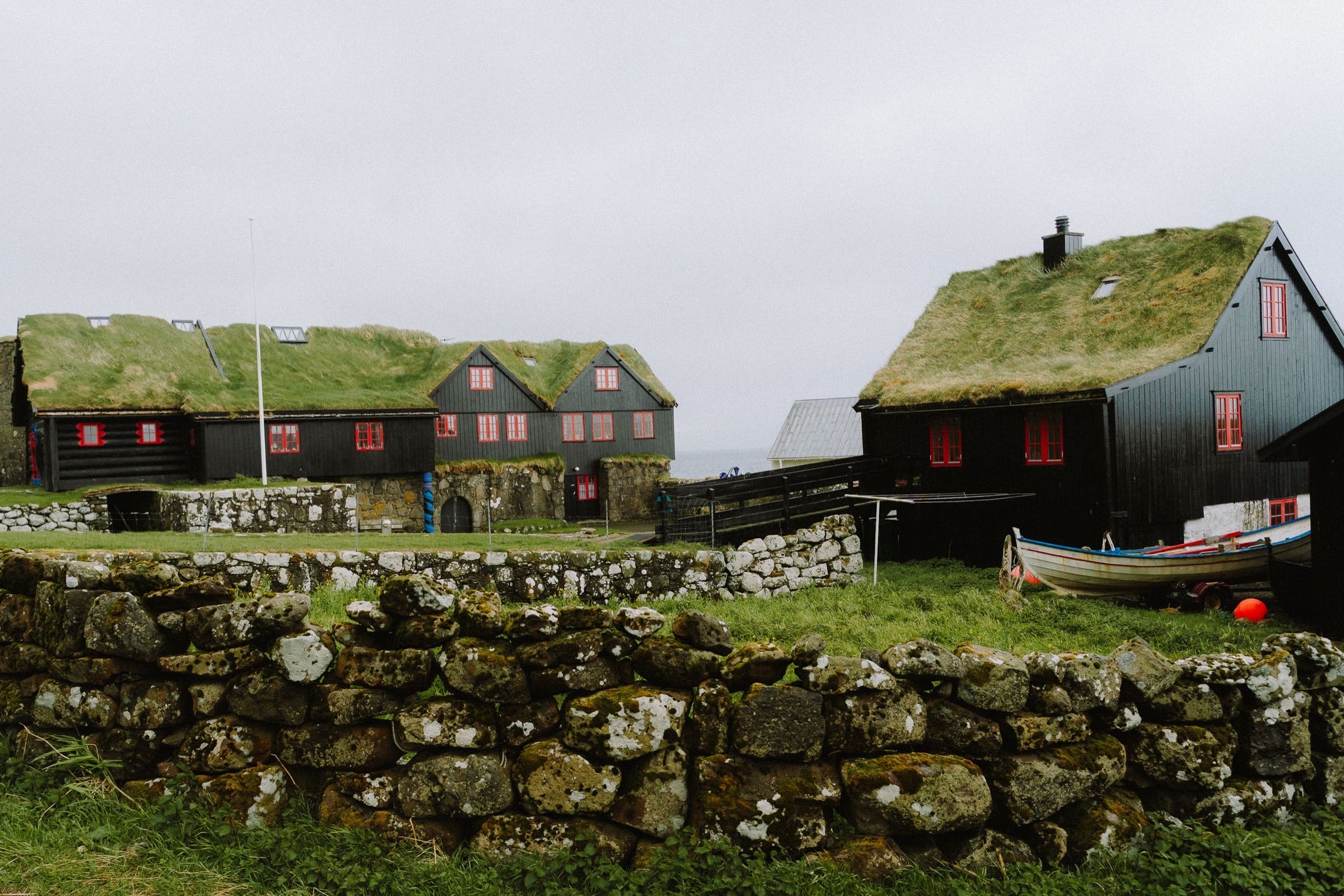
A short drive south of Tórshavn, with Kirkjubøargarður (one of the oldest inhabited wooden houses in the world), St. Olav's Church and the unfinished medieval St. Magnus Cathedral. Good when the weather in the north is poor.
-
Viðareiði and Villingadalsfjall (Viðoy)
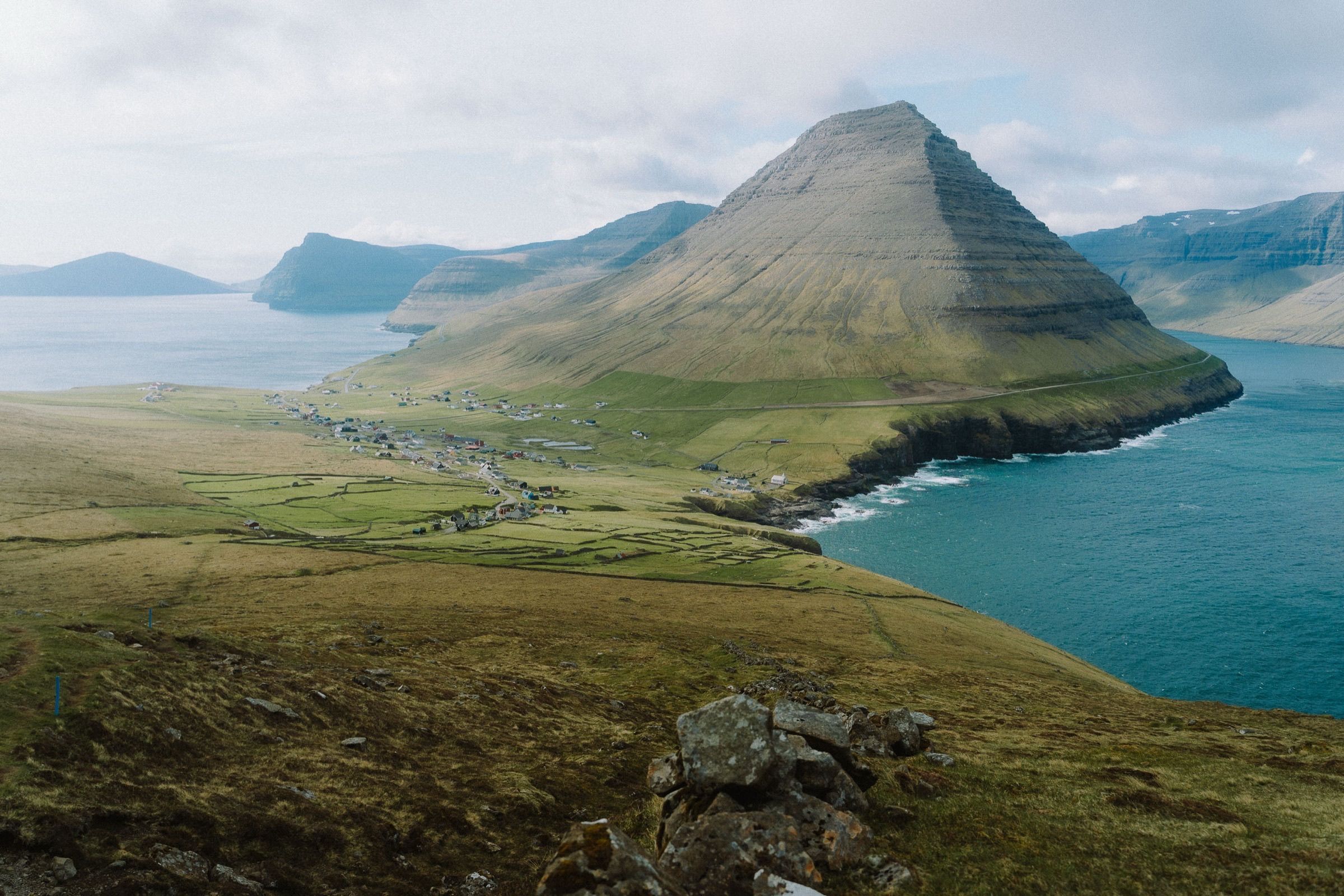
The northernmost village in the Faroes, with the mountain Villingadalsfjall above it. Hiking Villingadalsfjall costs DKK 200 per person, paid in the mailbox by the trail gate. Enniberg requires a booked guide.
-
Klakkur (Borðoy)
A ridge viewpoint above Klaksvík looking over the northern islands and fjords, reached on foot from the town (roughly two hours return). No hiking fee is listed. The last stretch is steep and can be boggy, so it suits a small, fit group.
-
Kallur lighthouse (Kalsoy)
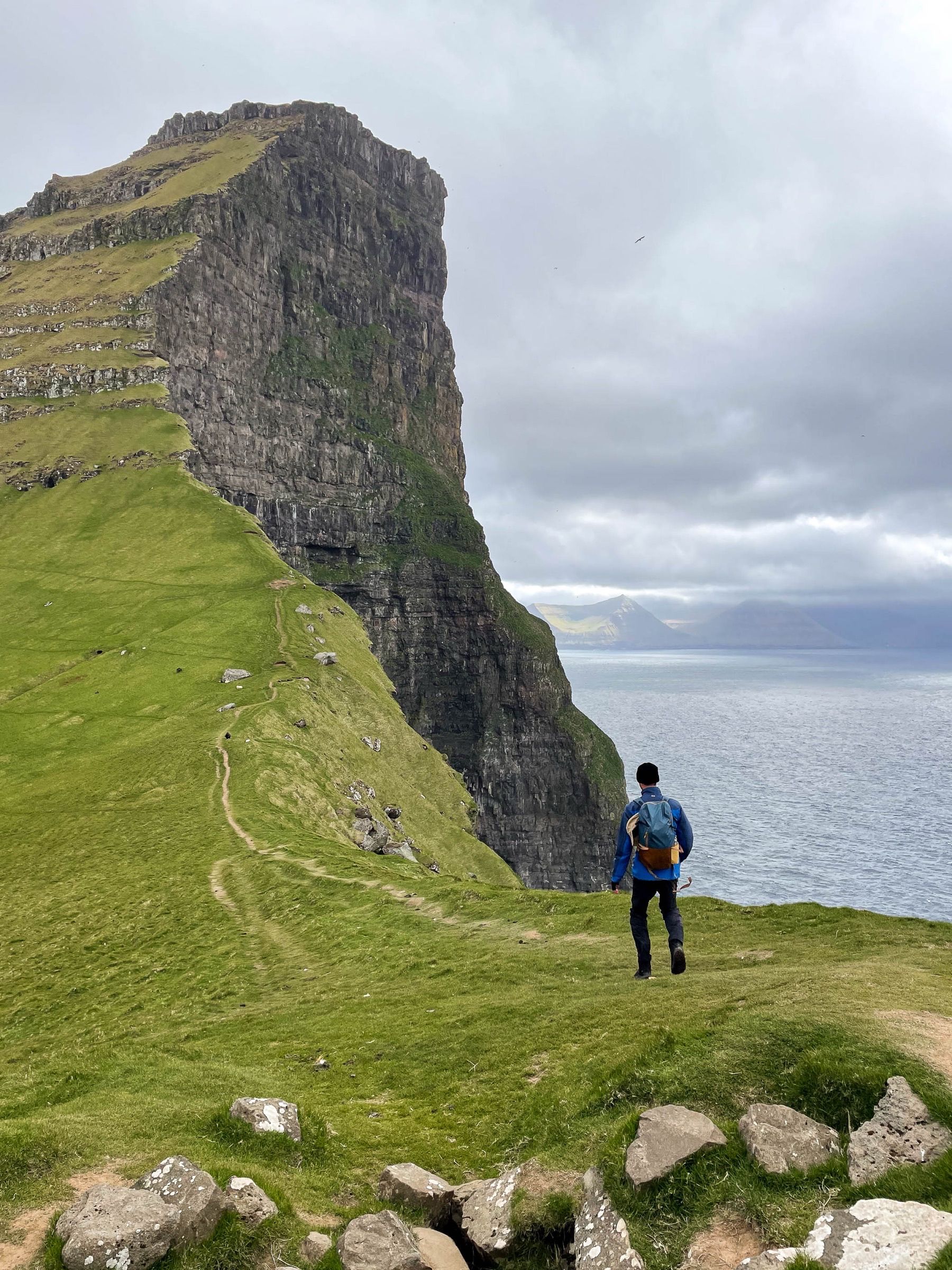
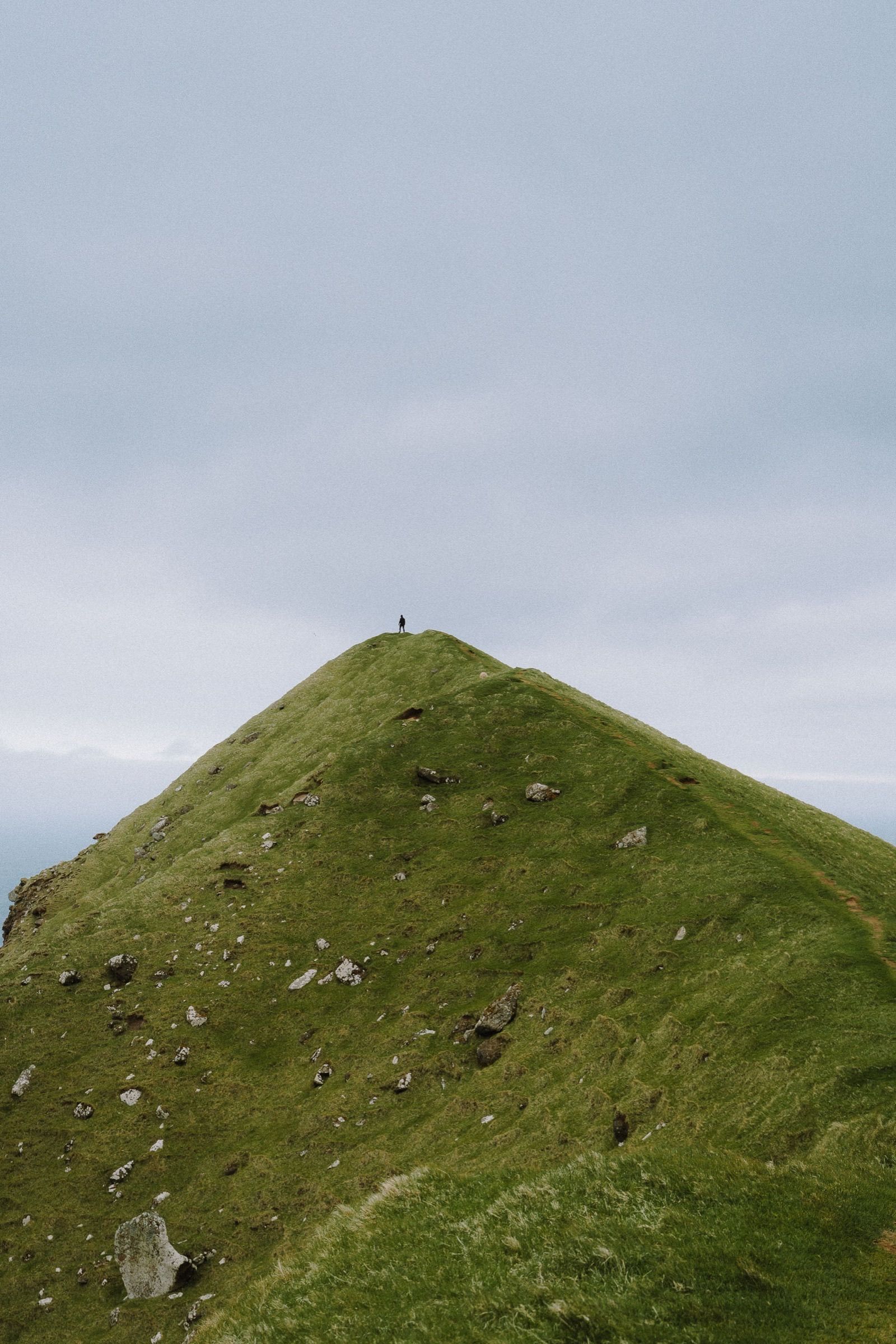
A lighthouse on a sharp ridge at the north end of Kalsoy, reached by ferry and a hike. There's a mandatory fee of DKK 200 per adult (DKK 100 for ages 13 to 17). Exposed and dramatic, and only right for a clear, calm day.
FAQ: Locations
What are the best places to elope in the Faroe Islands?
It depends on what you want. Saksun, Gjógv and Funningur are quiet, village-scale places. Tjørnuvík and Fossá are easy to reach. Trælanípa and Kallur are dramatic but take a hike and a fee. I'll suggest a mix that fits your day and the weather.
Do we have to pay to visit some locations?
Some, yes. Trælanípa, Kallur and Villingadalsfjall have mandatory fees, and others may charge for access across farmland. Visit Faroe Islands says the fees are under review after new sustainable tourism legislation. Fees change, so I check them when we plan.
Can we go anywhere we like?
Not quite. Much of the land is private or used for grazing. Stick to marked paths and public places, and ask before crossing fields. I'll plan our route so we're welcome where we stand.
Do we need permission to have a ceremony at a location?
It depends on the place. Many popular trails are on private or farmed land, and the landowner or a local group may run an online booking portal, a payment box at the trailhead, or a mandatory guided tour (Drangarnir is one example). In my experience, these are best arranged well in advance, and I plan them with couples. Churches and larger groups need permission too.
Want help choosing places? Tell me what you have in mind, or see my Faroe portfolio.
05 · Planning
Planning your trip
Getting there from the US
There are no regular nonstop flights from the US right now, so you'll connect once. Check current routes, since direct flights from the US have changed over time.
- Via Reykjavík (Keflavík): Icelandair flies from many North American cities to Keflavík and on to the Faroe Islands. The Faroe route is being extended to year-round service from winter 2026.
- Via Copenhagen: Nonstop flights run to the Faroes from Copenhagen, with more departures than from any other city.
- Via Edinburgh: nonstop flights take a little over an hour.
- Nonstop from New York: Atlantic Airways launched a seasonal New York Stewart route in 2023, but it has since been reported as canceled. Check current routes before you book.
- By ferry: Smyril Line sails from Hirtshals in Denmark and from Iceland.
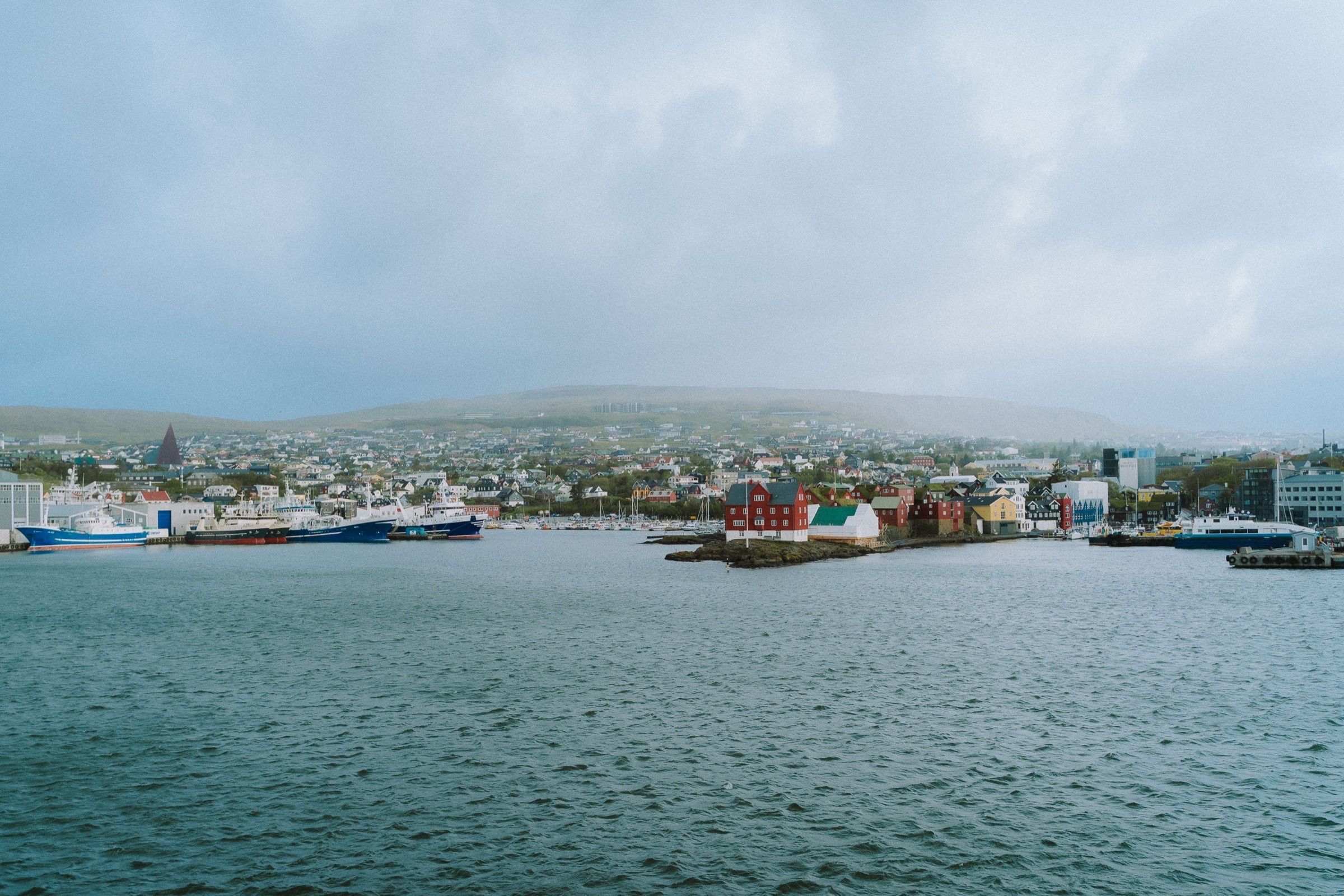
You'll land at Vágar Airport (FAE), about 45 km from Tórshavn.
A car makes it easy
You can get around by bus and ferry, but for an elopement day a rental car is close to essential. Locations are spread across several islands, and we'll want to move with the light.
Driving basics:
- Drive on the right.
- Speed limits are generally 50 km/h in towns and 80 km/h on rural roads.
- Headlights must be on at all times.
- Several tunnels are single-lane with passing bays. Check the signs for who gives way.
- Sheep stand on the road. Slow down, and report it to the police if you hit one.
- Four subsea tunnels charge tolls, paid online at tunnil.fo within three days. Ask your rental company how it handles them.
- US licenses: check the rental company's current requirements for your license.
Money, language and everyday things
- Currency: the Faroese króna, tied 1:1 to the Danish krone. Danish notes are accepted everywhere.
- Cards: widely accepted, including on the smaller islands, though most places do not accept American Express. Carry a little cash.
- English: widely spoken.
- Tipping: not expected. Rounding up for good service is fine.
- Tap water: clean and drinkable.
Are the Faroe Islands "closed to tourists"?
No. Once a year, Visit Faroe Islands runs "Closed for Maintenance," when selected popular sites close for a weekend while volunteers repair paths. Dates change from year to year, so check visitfaroeislands.com before you travel. The rest of the islands stay open. Avoid that weekend if a specific site matters to you.
Separately, some hikes have fees, and since February 1, 2026 there's a sustainability fee of DKK 20 per night for guests aged 16 and over in paid accommodation.
How many days?
Plan at least four or five days, with your elopement day in the middle. Flights can be delayed by weather, and a spare day gives us room to move the photographs if a storm comes through.
FAQ: Planning
How do we get to the Faroe Islands from the US?
Fly to Reykjavík or Copenhagen, then take a short flight to Vágar. Icelandair connects many US cities through Reykjavík, and Atlantic Airways and SAS fly from Copenhagen. Check current routes and seasons before you book.
Can we get around without a car?
For sightseeing, yes, with buses and ferries. For an elopement day moving between several locations, a car is far more practical, and it lets us follow the weather.
Is driving difficult?
Not really. Roads are good, traffic is light, and you drive on the right. Take care in single-lane tunnels, on narrow village roads and around sheep.
Do people speak English?
Yes, English is widely spoken, especially by younger people and anyone working in tourism. I speak Danish, English and Spanish myself.
What currency do they use, and do we need cash?
The Faroese króna, worth the same as the Danish krone. Cards are widely accepted, but check with your bank before you travel.
Should we tip?
It isn't expected in restaurants, cafés or taxis. You can round up if you'd like to.
Can we drink the tap water?
Yes. Tap water is clean and safe to drink.
Are the Faroe Islands closed to tourists?
No. Only selected sites close for a weekend during "Closed for Maintenance." Dates and fees change from year to year, so check visitfaroeislands.com before you travel. Some hikes also have fees.
Ready to start? Tell me about your plans or see packages.